Marketing runs on opinions. Yours should run on measurements.
What people actually search for, and what your site actually tells the machines that rank it. Measured before you spend.
Every finding, with its receipt.
- 200 credits free
- No card
- Five audits a month

It is not just SEO. Eleven disciplines, and what we will and will not do in each.
Most of this is sold as separate retainers by separate agencies. Here it is one system. The $149 audit and every plan run the rule-based checks; the AI specialists and the AI-written tools run on the Growth plan and up. Nothing here acts on your accounts.
Search
- SEOSearch engine optimisation
- Technical crawl, keyword research, internal link architecture, page speed and structured data: everything that decides what a search engine can actually read on your site, with the URL attached to every finding. A site audit reads up to your plan’s page limit, from 5 pages on Free to 1,000 on Agency, and a page you watch can be re-read daily, with an alert in the app when its status, indexability, canonical, title or score changes. Keyword suggestions, a competitor keyword gap and your backlinks are built and switched off until we confirm their prices and switch their paid data source on; backlink intelligence on top of your backlinks (the anchor text, which links are marked nofollow or sponsored, the links gained and lost each month, and linking sites that share one IP range) is priced and waits on the same data source. From your backlinks you will be able to pick links for a disavow file, free, shown with Google’s warning that most sites never need one; we never submit it. 5 specialists
- AEOAnswer engine optimisation
- Featured snippets, People Also Ask, FAQ schema and voice answers, plus whether the answer engines are allowed to read you at all: 16 AI user agents checked against your robots.txt on every audit. On every plan, the AI readiness check reads a page as it is sent, before any script runs, and shows how easily an answer can be lifted from it; the AI visibility overview puts a site’s readings on one page, with no combined score, and adds the free sources for your own site, each under its own name, on Growth and up: your Copilot citations from Bing’s export, and your Search Console traffic once it is switched on here and connected. We do not measure whether an assistant cites you through logged-in sessions to ChatGPT and Perplexity, and we will not ask you for those. DataForSEO’s records of AI answers and answer boxes, and the pages Google’s AI Overviews cite for your phrases, are built and switched off until we confirm its prices and switch that paid data source on. 1 specialist
- GEOGenerative engine optimisation
- Getting cited inside AI answers. Separate tactics for ChatGPT, Perplexity, Gemini, Bing Copilot and Google’s AI overviews, because they read different sources and reward different things. On Growth and up, the fan-out check takes one question, has a language model list the narrower questions an AI search could split it into (a model’s list, not queries any engine was seen to run), and shows which passages of your page match each one. On every plan, the entity check reads whether your site says plainly who it is and whether the profiles it lists name it back; a Google Knowledge Graph lookup is built and switched off until connected. On Growth and up, free: upload the file you export from Bing’s AI Performance report and see which of your pages Copilot cites, and the grounding queries behind them, as Bing counts them. On every plan, AI readiness also lists a page’s sources, quotations and figures: in a 2024 study (GEO, KDD 2024) adding them was among the edits that most raised a page’s visibility in AI-written answers, measured on the study’s own test engine and, for 200 of its questions, on Perplexity in 2023, not on any engine as it runs today. It counts what is on your page and predicts no citation. Which sites AI answers cite for each of your topics, from DataForSEO’s records, is built and switched off until we confirm its prices and switch that paid data source on. 1 specialist
Content and conversion
- ContentPages, publishing, review
- Fully drafted pages for the gaps we measured, not a list of topic ideas, graded by a separate reviewer. Publishing them is yours to do: we never log in to your site or push anything to it. On every plan, related terms: the words competitor pages use that yours never does, a count and not a ranking factor. On Growth and up, tools that compare pages by meaning, and Ask your site, which answers a question from your own pages and quotes the passages it used. 2 specialists
- ConversionAfter the click
- The page can rank perfectly and still convert nobody. Forms, calls to action, trust signals and friction, plus accessibility checks that carry real AODA exposure for an Ontario business. On every plan, the trust-signal check lists what a page shows about who stands behind it: author, about, contact and policy pages, dates, sources and review markup. It is a list, not a Google score: Google says E-E-A-T is not itself a ranking factor. 2 specialists
Reach
- OutreachWho to approach, drafted
- Who to approach and what to say, drafted from the strategy; a read of an enquiry you paste in; and an email authentication check, because sending from a domain with no SPF or DMARC burns it. On every plan, free: Link prospects, your list of pages that could link to you. We read each page you add once (does it name your business, link to you, list resources, and which of up to 10 of its outside links are dead) and, because Canada’s anti-spam law puts the proof of consent on the sender, keep a record for each contact address: where it is published, when we saw it, whether that page refuses unsolicited messages, and your note on why your message suits the role. Pitch drafts are on Growth and up; you export the list and send from your own mailbox. Paid searches for pages that name you without a link, pages that link to dead pages, and resource pages are built and priced, and switched off until we switch their paid data source on. On Growth and up, free: sponsored placements. Record a paid placement you arranged and we check that the link is on the publisher’s page, marked rel="sponsored" as Google asks of a paid link, on a page search engines may index, then re-check it every week. A placement buys the publisher’s readers and a mention of you, not rankings, and ordering one through us is not set up: we have not signed a placement vendor. We draft. We never send email for you. 3 specialists
- Paid mediaThe landing page, not the account
- Running your campaigns is not offered: it would mean holding your ad-account logins and spending your budget, and reading results back needs the same access. What runs, on every plan, is a check of the page an ad sends people to: the ad and analytics tags its HTML loads, whether a click id and UTM tags survive its redirects, and how far down the first form or button sits. A return-on-investment calculator works from the numbers you type: arithmetic, not a forecast. no specialist
- Channel-level review for anyone publishing video; it needs your YouTube channel and a YouTube API key. Posting to your social accounts is not offered: it would need their logins. On every plan, the share preview check shows what a link to your page displays on Facebook, LinkedIn, X, WhatsApp and Slack, with the image measured from the file against each network’s published rules. On Growth and up, posts drafted from a page and checked against your own site, for you to post. 1 specialist
- Local & app storeFound where you operate
- Google Business Profile, reviews and directory citations for a service area; listing, keyword and screenshot work for a mobile app. On Growth and up, the app listing check reads an App Store or Google Play page against each store’s limits and suggests rewrites. Your own Business Profile reviews and your replies to them, read and never answered for you (free, Growth and up), and a Google rating lookup for any business, competitors included (its rating, review count and the up to five reviews Google returns, at the audit-page price), are built and available once connected. A paid reviews reader and a local map grid (where your listing appears in Google Maps at points around your business) are built and switched off until we confirm their prices and switch their paid data source on. 2 specialists
Intelligence and orchestration
- IntelligenceCompetitors and analytics
- Per-competitor analysis of what they cover that you do not, and read-only reporting. We never ask for your analytics login. Your own Search Console figures (clicks, impressions, click-through rate and position, with the results seen often and clicked rarely) and Google Analytics figures (sessions, engaged sessions and key events by landing page, beside Search Console’s) are built as read-only links you would grant on Google’s own page; both are switched off and become available, on Growth and up, once Google approves our app. Your Bing Webmaster Tools figures (clicks, impressions and Bing’s own position for your searches and pages, the links Bing has found to your site, crawl problems), read through Bing’s read-only sign-in, are built too: free on Growth and up, available once switched on, and labelled as Bing’s, never Google’s. 2 specialists
- OrchestrationThe part that runs it
- A strategist that plans the campaign before any doer runs, and a build planner that turns that plan into a dependency graph of tasks. Every run captures the exact prompt sent and the raw response received. 2 specialists
Send us your URL. We send back the list of what is actually broken.
- Up to 60 pages read the way a search engine reads them
- Whether AI answer engines can read you at all: we check
robots.txtagainst 16 crawlers, including GPTBot, ClaudeBot and PerplexityBot - Email DNS, accessibility and conversion, not just SEO
- Every finding carries the raw observation it came from, so you can check it before you act on it
The button opens an email to singhsainivikram@gmail.com with your URL filled in; if nothing opens, write to that address. We need your URL, your market (city and country) and one sentence about what you sell. We never ask for logins to your site, your analytics or your ad accounts.
Two measurements, and the gap between them.
The $149 audit is a document, not a dashboard login: the raw evidence is attached, so you can hand it to any developer and they can act on it without talking to us. The self-serve app shows the same evidence on screen.
What your market searches
We pull live suggestion data for your category and city, strip the noise (job-seekers, other provinces, retail intent) and keep only phrases a buyer types.
What your site actually says
We read your pages the way a crawler does, and more than the homepage: service pages first. The crawl is capped at 60 pages and the report tells you when a site hit that cap.
The gap between the two
The phrases with real demand that you have no page for, with the ones a page of yours already names in its title, headings, description or address marked as covered, so you can see the difference. The gap list reads your pages, not your rankings.
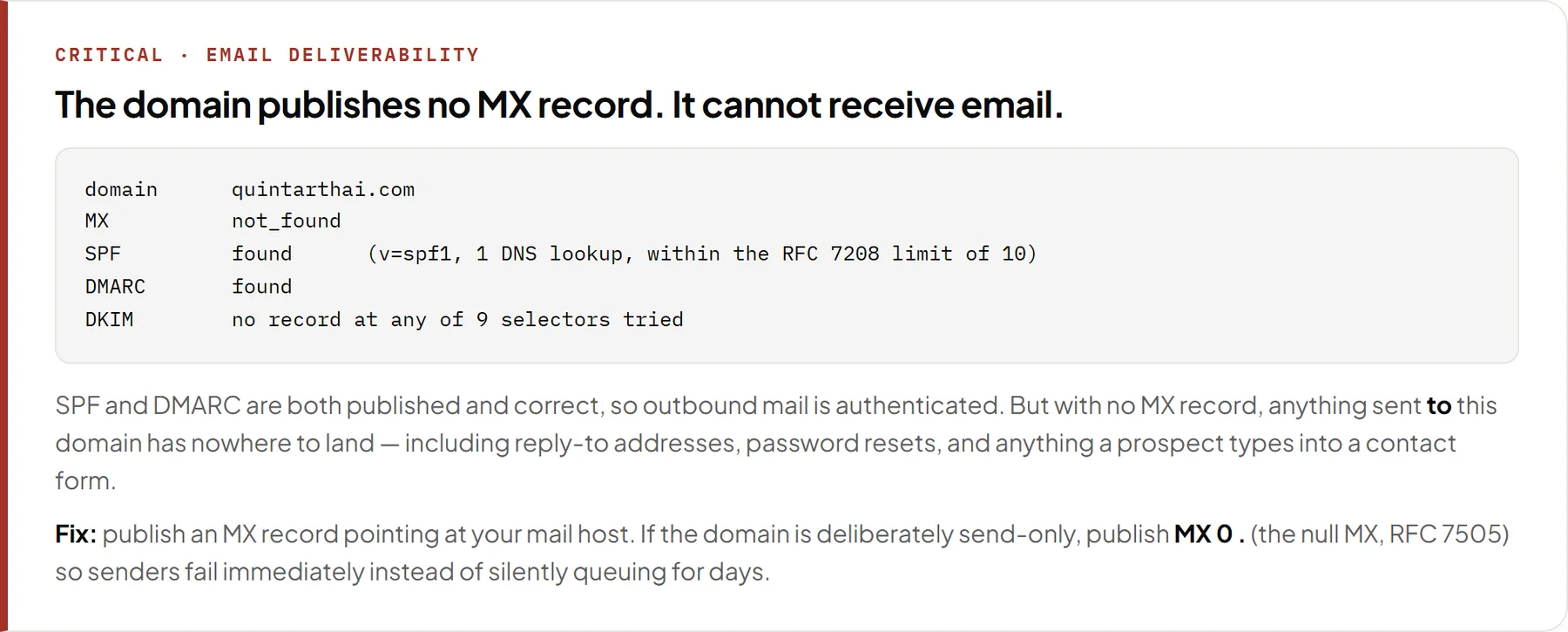
One finding from a real audit, as it was delivered.
From the audit we ran on quintarthai.com, a site we own, on 29 August 2026. The raw observation sits above the fix, so you can check it before you act on it.

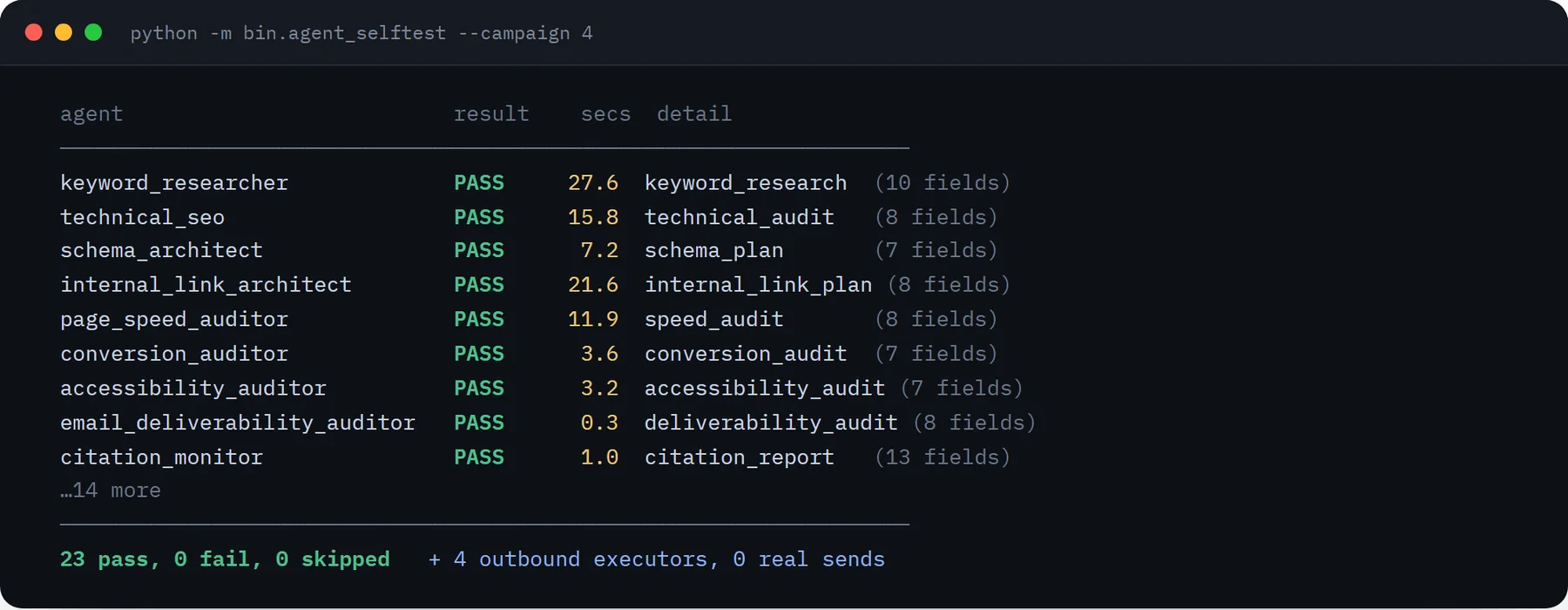
Twenty-seven agents in the engine. What each one does today.
The audit is the front door, and it runs no model. Behind it is a registry of separate agents, each responsible for one discipline: 17 run in order in the full pipeline (Growth plan and up), 5 are not offered because they would act on your accounts or measure nothing, and 5 need an input a website cannot give. Here is all of it.
Every check we run, on one screen
52 checks that between them raise 104 distinct findings. Each square is one check; hover or focus it to read what it looks for. Nothing here is a category we invented for a screenshot: it is the list the engine iterates.
- Its relative links stay on this site
- It names a clean, absolute canonical address for itself
- Its canonical address answers directly
- It declares its text encoding where browsers look for it
- The site publishes robots.txt and names a sitemap in it
- Its language alternates are valid
- Each language alternate answers and links back
- Each language alternate can be read and points one way
- It is served compressed
- It is served over HTTPS
- Search engines may index it and follow its links
- Its links to its own pages use https
- Its links to its own pages are ones crawlers may follow
- Its address reaches the page in one secure hop
- Its robots directives are valid and consistent
- Your robots.txt allows this page
- Its links agree with its own crawl rules
- It carries structured data
- It loads nothing over plain http
- It sends the security headers browsers act on
- Its sitemap listing agrees with its indexability
- Its structured data actually parses
- Its address has no doubled slash or capital letters
- It has a viewport tag for phones
- Its viewport lets a phone fit and zoom the page
- Its inner pages carry a breadcrumb trail
- It declares an icon the browser can fetch
- It has a meta description of a usable length
- Its description says more than its title
- Its share card has a title, an image and an address
- Its share-card fields are valid and complete
- Its share cards are not truncated
- It gives X the fields a card needs
- It has at least 300 words of text
- It uses no obsolete HTML tags
- It has one main heading of a usable length
- Its headings run in order, with subheadings on a long page
- Its images use a modern format
- It links onward into its own site, not mostly off it
- It avoids inline styles, empty links and meta refresh
- Its HTML is not oversized in bytes or elements
- It declares its title, canonical and description once each
- It has a title of a usable length
- Its alt text describes the image
- Every link has text a reader can follow
- Each element id is used once
- It labels its form fields
- Its embedded frames say what is inside them
- Its images have alt text
- Its declared language is a tag a browser can read
- It declares its language
- AI answer engines are allowed to read it
- Technical 52of 104
- Presentation 21of 104
- Structure 18of 104
- Accessibility 9of 104
- AI answers 4of 104
The score is arithmetic you can redo
A page starts at 100 and each finding subtracts by severity. These four numbers are the whole model, drawn to scale, because a weight you cannot see is a weight you have to trust.
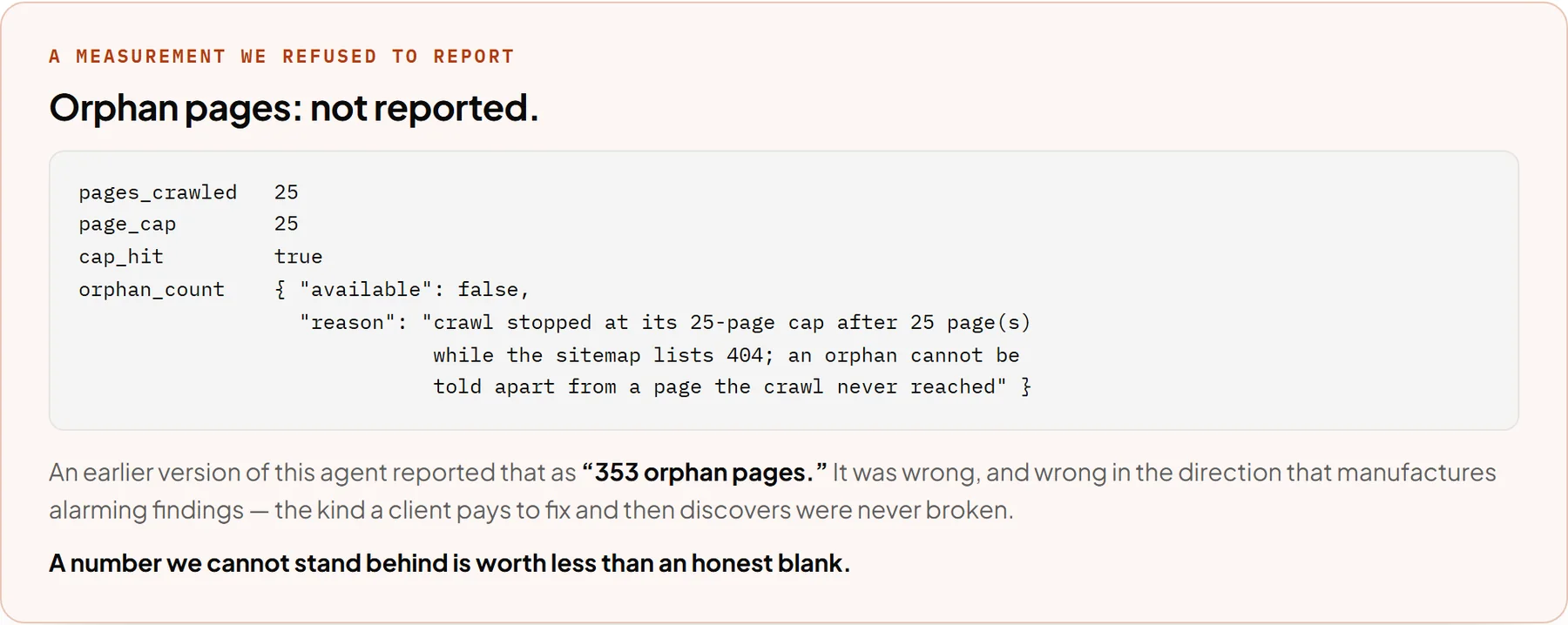
Three things we refuse to score
Every competitor prints a number here. We print the reason there is no number, because an invented one is worse than a gap.
- AuthorityNeeds a backlink index - referring domains, link quality. An audit reads your page, not the links other sites point at it, so any number here would be invented.
- Core Web VitalsNeeds lab or field performance data (LCP, CLS, INP). One HTML fetch cannot measure what a browser does after load.
- Content qualityWhether writing is good, deep, or matches intent is a judgement, not a measurement. We score the STRUCTURE of the content and say so.
- Technical SEOCrawls the live site and reports what is actually broken, with the URL attached.
- Keyword researchPulls real search data for your market rather than a paid tool's estimate.
- Structured dataReads the Schema.org markup on every page and writes what is missing. It will not invent a rating or an address to fill a gap.
- Internal linkingBuilds the actual link graph: orphan pages, click depth, and anchor text that says nothing.
- Answer-engine optimisationFeatured snippets, People Also Ask, voice answers and FAQ schema.
- Generative-engine optimisationGetting cited inside AI answers, engine by engine.
- Citation monitoringNot offered. Reading whether an assistant cites you needs logged-in sessions to ChatGPT, Perplexity and Gemini that we will not ask for, and it has never taken a reading, so we do not sell it. A different route, reading the AI answers DataForSEO has recorded, is built and switched off until we confirm its prices and switch that paid data source on. What is offered instead, on Growth and up: Bing’s own count of how often Copilot cites your pages, from the AI Performance file you export from Bing.
- Content optimiserProduces fully drafted pages for the gaps, not a list of topic ideas.
- PublisherNot offered. Publishing to your site would mean holding its logins and acting for you. Approved pages are yours to publish.
- Competitive intelPer-competitor analysis of what they cover that you do not. It needs the competitors named; in the recorded run the plan named none, so it produced nothing.
- AnalyticsAdvisory reporting. Read-only, and no account access is requested. A read-only Google Analytics link is built and switched off until Google approves our app; your Bing Webmaster Tools figures, read through Bing’s read-only sign-in, are built and available once switched on.
- OutreachDrafts who to approach and what to say. Nothing is sent. In the recorded run the plan named no one, so it produced nothing.
- Cold emailNot offered. Sending email for you is acting for you, and we do not.
- SocialNot offered. Posting to your accounts would need their logins. What is offered instead: a check of what a shared link shows, and posts drafted for you to post yourself.
- Ad campaignsNot offered. It would spend your ad budget, and we never act on your accounts.
- Lead qualificationReads an enquiry you paste in and says how well it fits. It needs the enquiry, so the pipeline does not run it.
- Email deliverabilityChecks SPF, DKIM and DMARC before a single message is sent. Sending from an unauthenticated domain burns it permanently.
- Page speedMeasures response time, page weight and render-blocking assets. Where real Core Web Vitals cannot be captured it says so instead of guessing.
- ConversionWhat happens after the click: forms, calls to action, friction. No invented percentage lifts. We do not run your A/B tests.
- AccessibilityWCAG markup checks. Real AODA exposure for an Ontario business, and the same semantics search engines read.
- Local presenceThe plan for a business with a service area. The pipeline does not run it yet; the free local check in the app reads the same page.
- App store optimisationListing, keywords and screenshots, for mobile apps. It needs an app-store listing, not a website.
- YouTube auditChannel and video-level review. It needs your channel and a YouTube API key, not a website.
- StrategistPlans the campaign before a single doer runs.
- Build plannerTurns that strategy into the actual task graph, with dependencies.
- Quality reviewerScores every agent's output and recommends ship or rework.
- Campaign optimiserWould read results back and adjust the next cycle. It needs performance data from accounts you would have to connect, and we do not ask for them, so it does not run.
Most of the market means “Google and ChatGPT” when it says AI search. The generative-engine agent produces separate tactics for five, because they cite different sources and reward different things.
We publish that split rather than describing all 27 the same way. A firm whose pitch is “we tell you what we actually measured” does not get to be vague about its own product.
Your coding agent applies the fix. We still never touch your site.
Quinndatum speaks MCP. Point Claude Code, or any MCP client, at your account, and the audit stops being a document somebody has to read and retype. Your agent reads the findings, takes the patches, and puts them in your repository as a diff you review like any other.
We hold nothing, and that is the point
No account access. No write access. No script on your pages. Your agent runs on your machine, with your key, in your codebase. The change lands in your git history and stays there, including after you stop paying us.
That is the exact opposite of a tool that injects itself into your site and takes the improvements back when the subscription lapses.
It is told what not to invent
An agent handed only findings will confidently write all of them. Ours is handed the refusals too: what we would not score and why, which inputs were missing and whose limit that was, and the rule that a check whose input was missing did not run; it did not pass.
The patches arrive beside the changes we refuse to write (a title, a meta description, an H1) because each is a claim about what your business is for, not a fact about your markup. Your agent brings those to you instead of guessing.
No new price
It spends the credits your plan already includes, at the rates the app charges: two to read a page, three for its patches, so a complete cycle is five. Your plan’s monthly audit allowance applies too. On Free that is 5 complete cycles a month: the plan includes 200 credits and 5 audits a month, and the audits run out first.
A key reaches four routes and nothing else. It cannot see your credits, your plan or your account, cannot send anything, and cannot make another key. Revoke it and it stops working on the next request.
What we will not promise you.
Most of what went wrong for you last time started with one of these. Separately, there are three things the engine refuses to score at all. Those are measurements we will not fake; these are promises we will not make.
-
A ranking position
Nobody controls Google's index. Anyone who guarantees a position is either guessing or counting on you not to check.
-
A traffic forecast
We can measure what demand exists. Turning that into a monthly visitor number would be a story, and you would have no way to falsify it.
-
That you need us afterwards
The audit is a document. If your fundamentals check out, we will say so and you can stop there.
-
A number we did not measure
Every covered phrase names the page that covers it and every struck phrase names the rule that struck it. Where we could not measure something, the report says so.
We run it for you, or you run it yourself. Every price published.
All prices in US dollars (USD), each published with what it does not cover. The order buttons open an email to singhsainivikram@gmail.com; if nothing opens, write to that address. See a real one we ran on ourselves.
One site, one pass. For deciding whether to spend anything at all.
- Up to 60 pages read, service pages first
- Live demand pulled for your category and city
- Every phrase we struck, and the reason why
- Email DNS, accessibility and conversion, not just SEO
The audit, then a second run 30 days later showing exactly which findings went green.
- Everything in the audit
- A second full run at 30 days, side by side with the first
- Per-finding pass or fail, with the value we observed and the date
- Proof the fix landed, or proof it did not
The same run, monthly. For sites that change often enough to break quietly.
- Full re-run every month
- You are told what changed since the last run
- DNS and accessibility regressions caught the month they appear
- Cancel in one email. No minimum term, no notice period
If it finds nothing you can use
A one-off audit is refunded in full only if it finds nothing you can act on; tell us within 30 days of delivery. We are betting the engine will find something you did not know: on our own site it found a domain that could not receive email.
Monthly plans, including Watch, cancel any time, with no partial refunds.
What we do not promise: rankings, traffic, or a number by a date. We do not publish your pages, so those are not ours to guarantee. Anyone promising you otherwise is guaranteeing something they do not control.
Or run it yourself: the self-serve plans.
Every account starts on Free. There is no checkout yet: to move tiers, email us at singhsainivikram@gmail.com and a person switches it on. Prices in US dollars. What a credit buys: a page audit is 2, Quinn’s fixes 3, a model-backed agent run 5 (Growth and up), and each re-read of a watched page 2, counted as one audit in your plan’s monthly allowance.
Audit one site and see the evidence. No card.
7 of 7 capabilities can be started today
- Site audit
- Quinn's fixes
- Dimension scores
- Local presence
- Publishing cadence
- Demand gap
- Client report (PDF)
Solo operators running their own site or a handful of clients.
7 of 7 capabilities can be started today
- Site audit
- Quinn's fixes
- Dimension scores
- Local presence
- Publishing cadence
- Demand gap
- Client report (PDF)
Agencies and in-house teams running several sites at once.
8 of 10 capabilities can be started today
- Site audit
- Quinn's fixes
- Dimension scores
- Local presence
- Publishing cadence
- Demand gap
- Client report (PDF)
- AI specialists (one, or all 17 in order)
+2 listed, not startable yet; the app says what each is waiting on.
Teams that publish and send, not just diagnose.
8 of 13 capabilities can be started today
- Site audit
- Quinn's fixes
- Dimension scores
- Local presence
- Publishing cadence
- Demand gap
- Client report (PDF)
- AI specialists (one, or all 17 in order)
+2 listed, not startable yet; the app says what each is waiting on.
Large client portfolios, with room to grow.
8 of 13 capabilities can be started today
- Site audit
- Quinn's fixes
- Dimension scores
- Local presence
- Publishing cadence
- Demand gap
- Client report (PDF)
- AI specialists (one, or all 17 in order)
+2 listed, not startable yet; the app says what each is waiting on.
The newest tools, and what each costs
Prices in credits, read from the same table the app charges from; a run we refuse costs nothing. Whether a tool runs on your account today is shown in the app, beside its Run button: some wait on a paid data account or a placement vendor.
| Tool | Who can use it | Price | Runs on |
|---|---|---|---|
| Link prospects | Every plan | FreeFree: your prospects, the pages you add, the CASL proof records and the CSV export cost nothing. A pitch draft is 3 credits, charged only when it is delivered (Growth and up). Finding prospects with paid data is priced on its own cards. | Pages you find; a pitch draft uses an AI model (ours) |
| Unlinked mentions | Growth and up | 20 credits per search answered20 credits when the search comes back with at least one page we could read; a search that finds nothing is free, and so is a refusal. | Paid web content data from DataForSEO |
| Broken-link prospects | Growth and up | 20 credits per site answered, up to 6020 credits for each site you name whose links come back with at least one page we could read, up to 3 sites; a site with none is free, and so is a refusal. | Paid backlink data from DataForSEO |
| Resource pages | Growth and up | 3 credits per results page read, up to 93 credits for each topic whose results page comes back with at least one page we could read, up to 3 topics; a topic with no result is free, and so is a refusal. | Paid Google results pages from DataForSEO |
| Sponsored placements | Growth and up | FreeFree: checking a placement costs no credits, now or weekly. | Placements you arrange (ordering through us once we sign a vendor) |
| Backlink intelligence | Growth and up | up to 75 credits a runUp to 75 credits a run, per part that comes back; the disavow file is free. | Paid backlink data from DataForSEO |
| AI readiness: sources, quotations and figures | Every plan | 2 credits | Nothing extra |
| AI topics | Growth and up | 100 credits per AI platform answered, up to 200100 credits for each AI platform DataForSEO answers for, up to 200 a run; a request they refuse is free. | Paid AI-answer data from DataForSEO |
The same money, over time
Bars share one scale, so the shortest is genuinely that short, and every total is printed beside it, so the scale is not doing the arguing.
- The audit, onceone pass, one date on it, done for you$149
- Audit + Watch, every month$149 once, then $79 a month, done for you$1,097
- Starter plan, every month$99 a month, the app, run by you$1,188
- The audit, onceone pass, one date on it, done for you$149
- Audit + Watch, every month$149 once, then $79 a month, done for you$2,045
- Starter plan, every month$99 a month, the app, run by you$2,376
Not like for like, and it matters. All figures are in US dollars. The $149 audit is one pass on one date, run by us; Watch is that run again each month, also by us. The Starter plan is the self-serve app: you run up to its monthly allowance of audits yourself, whenever you like.
What none of it includes
Published here rather than discovered later. Everything in this category has a real price above its advertised one; this is ours, stated up front.
- We do not do the work. You get findings and the fix for each, not published pages or deployed changes. In the app, each fix Quinn writes also carries the steps for the platform the page was built with (WordPress, Shopify, Wix, Webflow, Squarespace or plain HTML), read from the page itself.
- No ranking or traffic promise. Nobody controls a search index and we will not pretend to.
- No ongoing monitoring in the one-off audits. Each is one pass, one report, one date on it; Watch is the one that repeats. (In the self-serve app you can watch a page yourself, weekly or daily, at 2 credits a reading, with an alert in the app when it changes.)
- No logins, ever. We never ask for logins to your site, analytics or ad accounts. Search Console, Google Analytics and Business Profile, once switched on, are access you grant on Google’s own page and can remove at any time: read-only for the first two, and for Business Profile, where Google offers no read-only access, we only read. Bing Webmaster Tools, once switched on, is read-only access you grant on Bing’s own page; we never ask for an API key, and disconnecting deletes it.
- Not a full WCAG audit. Markup checks only; contrast and screen-reader behaviour are out of scope and the report says so.
- Not field performance data. Lab measurement, labelled as such.
Fair questions, direct answers.
Is this AI-generated?
The audit’s findings are not. They come from a live crawl of your site and live pulls of Google's own suggestion data, and the report shows the page behind every match and the rule behind every exclusion. Software does the reading; the judgement about what matters is ours, and where a reading looks unreliable we flag it instead of quoting it. On the Growth plan and up, the app can also run AI specialists; what they write comes from a language model, and the app says so.
How is this different from an SEO tool subscription?
We sell both, and they are different things. The $149 audit is a document: the defects on your site, the demand in your market and the phrases your site does not answer, with the evidence for each, ready to hand to a developer. The self-serve plans are an app you run yourself, monthly, with the same checks and the evidence beside every finding.
What do you need from me?
Your URL, your market (city and country), and one sentence about what you sell and to whom. No logins, no analytics access, no credentials of any kind.
What if the audit finds nothing wrong?
You get a short report saying your fundamentals check out. That is a real outcome and we will not manufacture a problem to avoid it. A one-off audit is refunded in full only if it finds nothing you can act on; tell us within 30 days of delivery.
Who is behind this?
Quinndatum is run by Harpreet Singh Saini in Ontario, Canada, working Eastern time. The audit method is the same one used on our own properties first. More about who runs this · what changed and when.